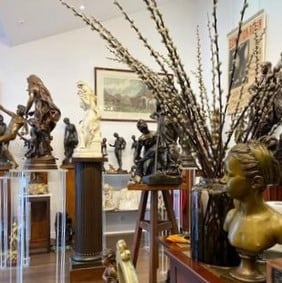
85, rue des Rosiers, Marché Biron - Stands 113, 114 & 115 Allée 1, 93400 SAINT-OUEN, France
carolinemiguet@icloud.com
+33 6 71 93 49 35


Antoine – Louis Barye (1795-1875)
Célèbre pour ses sculptures animalières , Antoine – Louis Barye est un fils d’orfèvre , qui se forme au travail des métaux , chez un équipementier militaire et chez Jacques-Henri Fauconnier .
En 1818 , il entre à l’Ecole des Beaux-Arts de Paris et fait son apprentissage dans l’Atelier du sculpteur François Joseph Bosio et du peintre Jean-Antoine Gros .
Après plusieurs échecs au Grand Prix de Rome , Antoine-Louis Barye claque la porte des Beaux-Arts en 1825 .
Il s’oriente ensuite vers la sculpture animalière qu’il va remettre au goût du jour .
Avec son ami Delacroix ,il se rend régulièrement à la ménagerie du Muséum d’Histoire Naturelle
pour étudier et observer les animaux .
C’est en 1831 que Barye se fait connaître du grand public en exposant au Salon « LeTigre dévorant un gavial » , œuvre mettant en scène un violent combat » d’une impressionnante virtuosité « .
Deux ans plus tard, il triomphe avec » Le Lion au Serpent » (plâtre) , qui sera également exposé avec succès dans sa version en bronze lors du Salon de 1836 .
Préférant le bronze au marbre jugé trop froid , l‘artiste multiplie les statuettes et les petits groupes animaliers qu’il fond et cisèle lui-même.
Antoine – Louis Barye meurt à l’âge de 80 ans , laissant derrière lui une importante production de dessins , aquarelles et peintures ainsi que des sculptures , pièces d’orfèvrerie .
Ses œuvres sont visibles au Musée du Louvre et au Musée d’Orsay .
Antoine – Louis Barye (1795–1875)
Famous for his animal sculptures , Antoine-Louis Barye is a silversmith’s son , who is trained in metalwork with a military equipment manufacturer and Jacques – Henri Fauconnier.
In 1818 , he entered the Paris School of Fine Arts and apprenticed in the studio of sculptor François Joseph Bosio and painter Jean-Antoine Gros .
After several failures at theThe Grand Prix of Rome , Antoine-Louis Barye slammed the door of the Fine Arts in 1825 .
He then turned to animal sculpture which he would bring back up to date .
With his friend Delacroix , he goes regularly to the menagerie of the Natural History Museum to study and observe animals .
It was in 1831 that Barye made himself known to the general public by exhibiting « The Tiger Devouring a Gavial » at the Salon , a work staging a violent fight « of impressive virtuosity ».
Two years later , he triumphed with « The Lion and the Snake » (plaster) , which was also successfully exhibited in its bronze version at the Salon of 1836 .
Preferring bronze to marble considered too cold , the artist multiplied statuettes and small groups animals,that he melts and chisels himself .
Antoine – Louis Barye died at the age of 80 , leaving behind an important production of drawings , watercolors and paintings as well as sculptures , pieces of goldsmith’s work .
His works can be seen at the Louvre Museum and Orsay Museum .
| Lieux | Marché Biron |
|---|---|
| Siècle | XIXe siècle |
| Style | Napoléon III |
| Type d'Objet | Antiquités |