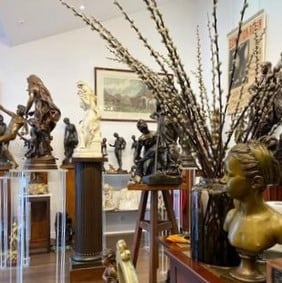
85, rue des Rosiers, Marché Biron - Stands 113, 114 & 115 Allée 1, 93400 SAINT-OUEN, France
carolinemiguet@icloud.com
+33 6 71 93 49 35



Christophe Fratin (1801 – 1864)
Christophe Fratin est un sculpteur français , pionnier du style animalier , il est présenté comme « le rival redoutable » d’Antoine-Louis Barye , dans la représentation des animaux.
Le sculpteur commence son apprentissage à l’École de Dessin de Metz .
Il fut l’élève de Carle Vernet et de Théodore Géricault à Paris .
Dès 1831 , il expose régulièrement au Salon .
Les succès répétés du sculpteur aux Salons de 1834 , 1835 et 1836 suscitent l’intérêt de l’aristocratie .
Christophe Fratin se distingue des autres sculpteurs de son époque par son ardeur à créer des modèles , et sa capacité à fournir des œuvres de grande taille .
Ses œuvres sont exposées à la Maison Susse , qui tenait un magasin passage des Panoramas à Paris , où elles sont alors proposées en plâtre .
C’est réellement en 1835 que démarrent les éditions des bronzes de Fratin .
Ses bronzes sont réalisés par la technique de la fonte au sable et en dimensions variables.
Il fut l’un des premiers , sinon le premier , à se lancer dans la sculpture d’édition .
L’ audience de Christophe Fratin devient rapidement internationale .
Il part pour l’Angleterre entre 1833 et 1834 .
Pendant toute sa carrière , l’intérêt de la clientèle anglaise ne se démentira pas .
L’artiste réalise aussi de grands groupes romantiques en Allemagne , à Potsdam , aux châteaux de Sans-Souci et de Babelsberg , où certains sont encore conservés .
Ce travailleur infatigable exportera même ses œuvres jusqu’à Saint-Pétersbourg , où elles décoraient le Parc de l’ Empereur de Russie .
Le romantisme transparaît d’une manière évidente dans ses sujets , où le cheval tient une place importante .
En 1837, le Salon devient hostile à la jeune génération romantique et la participation de C.Fratin se réduit à sa « Poulinière ».
Le sculpteur se concentre alors sur les éditions et la réalisation de petits modèles commerciaux .
En 1862 , il effectue sa dernière commande par décision ministérielle , « Chèvre et chevreau ».
Il se présente également lors de différentes expositions , telles , l’Exposition de la Société des amis des Arts de Bordeaux , l’Exposition Universelle de Metz , sous le patronage de l’impératrice en 1861 , ou l’Exposition universelle de 1862 à Londres.
Aujourd’hui , les sculptures de Christophe Fratin figurent dans les collections permanentes du Louvre , et de musées à Metz , Lyon , Strasbourg et Nîmes …
Christophe Fratin meurt le 17 août 1864 , au Raincy .
Il est enterré au cimetière de Montmartre .
Christophe Fratin (1801 – 1864)
Christophe Fratin was a French sculptor , pioneer of the animal style , he is presented as « the formidable rival » of Antoine-Louis Barye , in the representation of animals .
The sculptor began his apprenticeship at the Art School in Metz .
He was a pupil of Carle Vernet and Theodore Gericault in Paris .
From 1831 , he exhibited regularly at the Salon .
The sculptor’s repeated successes at the Salons of 1834 , 1835 and 1836 aroused the interest of the aristocracy .
Christophe Fratin stood out from other sculptors of his time for his eagerness to create models , and his ability to provide large-scale works .
His works were exhibited at Susse House , which ran a store Passage of Panoramas in Paris , where they were then offered in plaster .
It was really in 1835 that Fratin’s bronze editions began .
His bronzes were produced using the sand casting technique and in variable dimensions.
He was one of the first , if not the first , to engage in edition sculpture .
Christophe Fratin’s audience quickly became international .
He left for England between 1833 and 1834 .
Throughout his career , the interest of his English clientele never waned .
The artist also produced large-scale Romantic groups in Germany , in Potsdam , at the castles of Sans-Souci and Babelsberg , where some are still preserved .
This tireless worker even exported his works as far as St. Petersburg , where they decorated the Park of the Russian Emperor.
Romanticism is evident in his subjects , where the horse plays an important role .
In 1837, the Salon became hostile to the young Romantic generation , and C.Fratin’s participation was reduced to his « The Broodmare » .
The sculptor then concentrated on editions and the realization of small commercial models .
In 1862 , he carried out his last commission by ministerial decision , « Goat and Kid » .
He also took part in various exhibitions , such as the Exposition of the Society of Friends of the Arts in Bordeaux , Metz World’s Fair , under the patronage of the Empress in 1861 , and the 1862 Universal Exhibition in London .
Today , Christophe Fratin’s sculptures can be found in the permanent collections of the Louvre , and Museums in Metz , Lyon , Strasbourg and Nîmes …
Christophe Fratin died on August 17, 1864 , in Raincy .
He is buried in the Montmartre cemetery.
| Lieux | Marché Biron |
|---|---|
| Siècle | XIXe siècle |
| Style | Napoléon III |
| Type d'Objet | Antiquités |