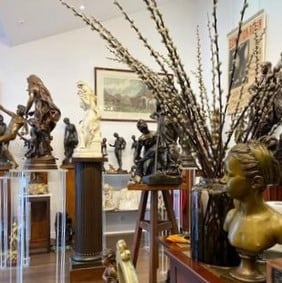
85, rue des Rosiers, Marché Biron - Stands 113, 114 & 115 Allée 1, 93400 SAINT-OUEN, France
carolinemiguet@icloud.com
+33 6 71 93 49 35


Louis Vidal (1831-1892)
Louis Vidal , dit « Vidal l’aveugle » ou encore « Vidal-Navatel » est un célèbre sculpteur animalier français .
Né le 6 décembre 1831 à Nîmes , il grandit dans une famille d’artistes , ayant pour beau-père le peintre « Alexandre Colin » qui a épousé sa mère en secondes noces .
Il commença sa formation par des cours d’anatomie , avant de devenir aveugle en 1853 , ce qui l’empêche de poursuivre cette voie .
Il décida alors de se tourner vers la sculpture .
Il étudie auprès des sculpteurs animaliers « Antoine-Louis Barye » et « Pierre Louis Rouillard » et devient lui-même sculpteur animalier en remplaçant la vue par le toucher .
Louis Vidal reste connu pour être l’auteur d’une sculpture représentant un « Lion rugissant » , ainsi que celle d’un « Taureau » en bronze , donné par l’État au Musée des Beaux-Arts de Nîmes en 1867 .
Louis Vidal travailla notamment avec Alfred Barye , fils de son maître Antoine-Louis Barye.
L’artiste devient professeur de modelage en 1888 à l’École Braille de Paris .
Son portrait effectué par le photographe »Étienne Carjat » , datant de 1865 , acquis parles Musées Nationaux en 1986 , est conservé à Paris au Musée d’Orsay .
Louis Vidal , meurt le 9 mai 1892 à l’hôpital des Quinze-Vingts , à Paris .
Louis Vidal (1831–1892)
Louis Vidal, known as « Vidal the Blind » or « Vidal-Navatel », was a famous French animal sculptor .
Born on December 6 , 1831 , in Nîmes , he grew up in a family of artists , his stepfather was the painter « Alexandre Colin » , who had married his mother in her second marriage .
He began his training with anatomy classes before losing his sight in 1853 , which prevented him from continuing on that path .
He then decided to turn to sculpture .
He studied under the animal sculptors “Antoine-Louis Barye” and “Pierre Louis Rouillard” and became an animal sculptor himself, relying on touch rather than sight .
Louis Vidal remains best known as the creator of a sculpture depicting a « Roaring Lion » , as well as a bronze « Bull » , which was donated by the government to the Museum of Fine-Arts in Nîmes , in 1867.
Louis Vidal worked notably with Alfred Barye , the son of his mentor Antoine-Louis Barye.
The artist became a professor of modeling in 1888 at the School « Braille » in Paris .
His portrait , taken by photographer Étienne Carjat in 1865 and acquired by the National Museums in 1986 , is housed at the Orsay Museum in Paris .
Louis Vidal died on May 9, 1892 , at the « Quinze-Vingts Hospital » in Paris .
| Lieux | Marché Biron |
|---|---|
| Siècle | XIXe siècle |
| Style | Napoléon III |
| Type d'Objet | Antiquités |